![Asset 2.svg]](https://help.truleo.co/hubfs/Asset%202.svg)
Here's what that looks like:
- ❌ Too vague: "Witness Information"
- ✅ More useful: "Summarize each witness's account in 2–3 sentences. Note any inconsistencies between statements. Flag any gaps where a follow-up question is needed."
The four templates below are the most-used in the library. For each section, copy the bold section name into the Section Name field and the description below it into the Section Description field.
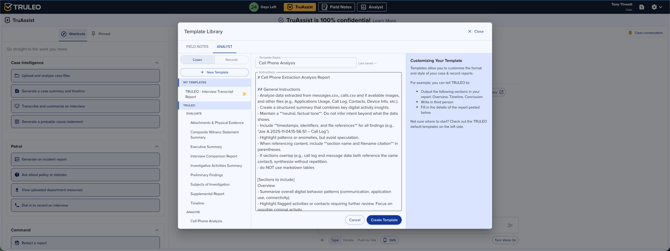
Interview Transcript Report
Use for: witness interviews, subject interviews, IA interviews
Statement Summary
Summarize the subject's full statement in chronological order, in 3–5 paragraphs. Use the subject's own language where possible — do not editorialize or draw conclusions. Note the approximate timestamp each major topic begins. If the subject contradicts themselves within the statement, note it briefly and flag it for the Inconsistencies section.
Key Statements & Timestamps
Extract 5–8 direct quotes that are most relevant to the investigation. For each quote: include the approximate timestamp, who said it, and one sentence explaining why it matters to the case. Flag any quote that directly contradicts known evidence or a prior statement.
Inconsistencies or Red Flags
Identify any statements that: (1) contradict known physical or digital evidence, (2) conflict with what other witnesses have said, or (3) shift between the beginning and end of this interview. For each inconsistency, describe what was said, what it conflicts with, and why it matters. If no inconsistencies are found, state "None identified."
Connection to Known Evidence
List every reference the subject makes to physical objects, locations, digital devices, vehicles, or other people involved in the case. For each reference, note what was mentioned, how the subject described their relationship to it, and whether it aligns or conflicts with what is already known about that evidence.
Credibility Assessment
Evaluate the subject's credibility across three dimensions: (1) Detail quality — are answers specific and consistent, or vague and rehearsed? (2) Cooperation — did they answer directly or deflect? (3) Behavioral signals — note any hesitations, changes in tone, or evasiveness around specific topics. Conclude with a one-sentence overall assessment: credible, partially credible, or not credible, with the primary reason.
Recommended Follow-Up Questions
List 3–5 specific questions the investigation should pursue based on gaps, inconsistencies, or unanswered threads in this interview. Each question should be targeted, not general — not "tell me more" but "You said you left at 9 PM but footage shows your vehicle at 10:15 — can you explain that?"
Composite Witness Statement Summary
Use for: multiple witnesses on the same incident
Agreed Facts
Identify the facts that two or more witnesses independently confirm without prompting from each other. List each agreed fact as a bullet with the names or IDs of the witnesses who confirmed it. These are the strongest foundation for the investigative narrative.
Conflicting Accounts
For each material conflict between witness statements, describe what each witness said, how the accounts differ, and which version (if any) is better supported by physical or digital evidence. Rank conflicts by significance to the investigation.
Most Credible Version
Based on corroboration with known evidence and internal consistency, synthesize the most credible account of what happened. Cite which witness(es) this version is primarily drawn from and why. Note where the synthesized version still contains uncertainty.
Gaps Requiring Follow-Up
List specific questions that none of the witness statements answer — either because no witness addressed them or because all accounts are equally unclear. For each gap, note what type of evidence (additional interviews, physical evidence, digital records) is most likely to resolve it.
Solvability Assessment
Use for: evaluating whether a case has enough to pursue
Evidence Summary
List all physical, digital, and testimonial evidence currently in hand. For each item: what it is, how strong it is (strong / supporting / weak), and whether it has any chain-of-custody concerns. End with a one-sentence overall evidence quality rating.
Lead Quality
List all current investigative leads. For each: describe it, rate its strength (hot / warm / cold), and note what action is needed to follow up. Rank leads from most to least likely to produce new evidence or suspects.
Witness Cooperation
For each key witness: rate their cooperation (cooperative / reluctant / uncooperative), note their reliability based on statement consistency, and flag anyone who has refused to speak or whose account has significant credibility issues.
Investigative Gaps
List the specific pieces of evidence, information, or confirmations that are missing and would materially strengthen the case. For each gap, note how likely it is to be filled and what it would take.
Recommendation
Provide a clear recommendation: Pursue (sufficient leads and evidence to continue active investigation), Hold (case should wait for a specific triggering event — describe what that is), or Close (insufficient evidence or leads to continue). Include a 2–3 sentence rationale.
Executive Summary
Use for: briefing a supervisor or prosecutor
Incident Overview
Describe the incident in 3–5 sentences: what happened, where, when, and who the key parties are. Write this for an audience that has not read any case files — it should stand alone.
Current Status
Describe exactly where the investigation stands today: what has been completed, what is actively in progress, and what has been paused or deprioritized. Keep it to 3–5 bullet points.
Key Evidence
Describe the 2–3 most significant pieces of evidence in order of importance. For each: what it is, what it proves or suggests, and its current status (in hand, pending lab, pending analysis, etc.).
Open Questions
List the 2–4 most important unresolved questions. Be specific — not "who did it" but "the subject's alibi for 9–11 PM on [date] has not been verified."
Recommended Next Steps
List 3–5 specific next actions, each with: what the action is, who should do it, and the timeframe. These should be concrete enough that a supervisor could follow up without additional briefing.
Best practices
- Customize section names and descriptions to match your agency's terminology — these are starting points, not requirements
- The more specific your section description, the more useful the output. Vague sections produce vague reports
- Duplicate an existing template from the TRULEO library first, then swap in these section descriptions
- For step-by-step instructions on creating and saving templates, see Analyst Report Templates